
Television series
The Ascent of Man
Bronowski's own sweeping essay-history, tracing humanity's climb from flint tools to relativity as one unbroken act of curiosity. Shot on location across the world, it moves slowly and thinks in complete paragraphs, culminating in a devastating stand at Auschwitz where the scientist becomes a witness. It's for people who want ideas delivered with conviction, not pace.
If you liked this
Civilisation1969
Kenneth Clark's series came first and Bronowski was partly answering it — same grand narrating intellect, same faith that one voice can carry the whole sweep of human achievement, just pointed at art instead of science.
But Clark's aristocratic certainty about what counts as civilisation has aged less gracefully than Bronowski's humanism.
Cosmos1980
Carl Sagan does for the universe what Bronowski did for human invention: turns hard science into something closer to scripture, delivered with the same unhurried, personal authority and total lack of embarrassment about wonder.
But More stargazing, less human history — if you loved the arch and the atom bomb episodes specifically, this drifts further into astrophysics.
Connections1978
James Burke's series shares the premise that technology is one long chain reaction, but plays it as intellectual sport — darting sideways from plough to computer chip with real showman's glee.
But Faster, cheekier, and more interested in clever links than in moral weight; it never stops to stand in a ruin and think.
The wildcard
Something you would not have found on your own.
2001: A Space Odyssey1968
Kubrick's 'Dawn of Man' sequence and Bronowski's series share a title, a thesis, and a founding image — tool-use as the hinge where animal becomes human.
A bone becomes a tool becomes a spaceship in one famous cut — the entire thesis of Ascent of Man compressed into a single wordless edit, five years before Bronowski said it out loud on television.
But It's a slow, elliptical science-fiction film with almost no dialogue for long stretches; patience required, and the ending offers no explanations.
More like this (7)
The Day the Universe Changed1985no page yet
Burke again, this time on how new ideas physically rearrange what people can perceive — a sharper, punchier cousin to Bronowski's thesis that understanding remakes the world.
But Very 1980s in its presentation, and less visually lavish than Ascent of Man's globe-trotting cinematography.
Civilisations2018no page yet
The modern, multi-presenter reboot of Clark's series, widened to include art beyond Europe — good if you want Ascent of Man's scale with contemporary pacing and a broader lens.
But Splitting the narration across presenters loses the single-authored, one-man-thinking-aloud quality that makes Bronowski's series distinctive.
Wonders of Life2013no page yet
Brian Cox tackling evolution and the meaning of life with the same wide-eyed, humanist enthusiasm Bronowski brought to invention — gorgeous photography, big questions, no cynicism allowed.
But Cox's breathy delivery and heavy visual effects are a world away from Bronowski's plain, standing-in-a-field authority.
The Story of Science: Power, Proof and Passion2010no page yet
Michael Mosley covers similar ground — the history of scientific ideas as human drama — with a more skeptical, myth-busting eye than Bronowski's reverence.
But Less poetic, more procedural; it's interested in how discoveries were actually made rather than in grand philosophical claims about progress.
Life on Earth1979no page yet
Attenborough's landmark series is the natural-history mirror to Bronowski's cultural one — same BBC era, same conviction that a patient, exact presenter can make deep time feel intimate.
But It's about the story of life on the planet, not the story of human thought — a different, if related, kind of ascent.
Copenhagen2002no page yet
Bronowski worked on the Allied bombing survey after Hiroshima and later stood at Auschwitz on camera; Copenhagen dramatises the exact moral crisis his series only gestures toward.
A tense two-hander drama imagining the real 1941 meeting between physicists Niels Bohr and Werner Heisenberg, wrestling with whether knowledge can be separated from what it's used for.
But It's a filmed stage play — dense, talky, and built around theoretical physics discussed almost entirely in conversation rather than image.
Powers of Ten1977no page yet
Where Bronowski narrates humanity's widening grasp of nature across thirteen hours, the Eameses show that same widening grasp in nine wordless minutes — same idea, radically compressed format.
Charles and Ray Eames's nine-minute short zooms from a picnic blanket to the edge of the observable universe and back down into an atom — scale made viscerally, vertiginously clear.
But It's over almost as soon as it starts, and offers no history or narrative — pure demonstration, not argument.
People
Cast
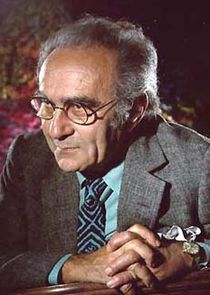 Jacob BronowskiPresenter